

Journey Sticks - mapping the landscape
The Journey Sticks workshops were born from a a text based visual arts project exploring home, belonging and landscape that was exhibited in 2019, here you can read more about it.
Eight Journey’s Home was a process-based project that explored a longing for home and the celebration of a journey’s end, it culminated in two installation pieces which were exhibited in the Matter Exhibiton at Glynde Place and during Art Wave in 2019.
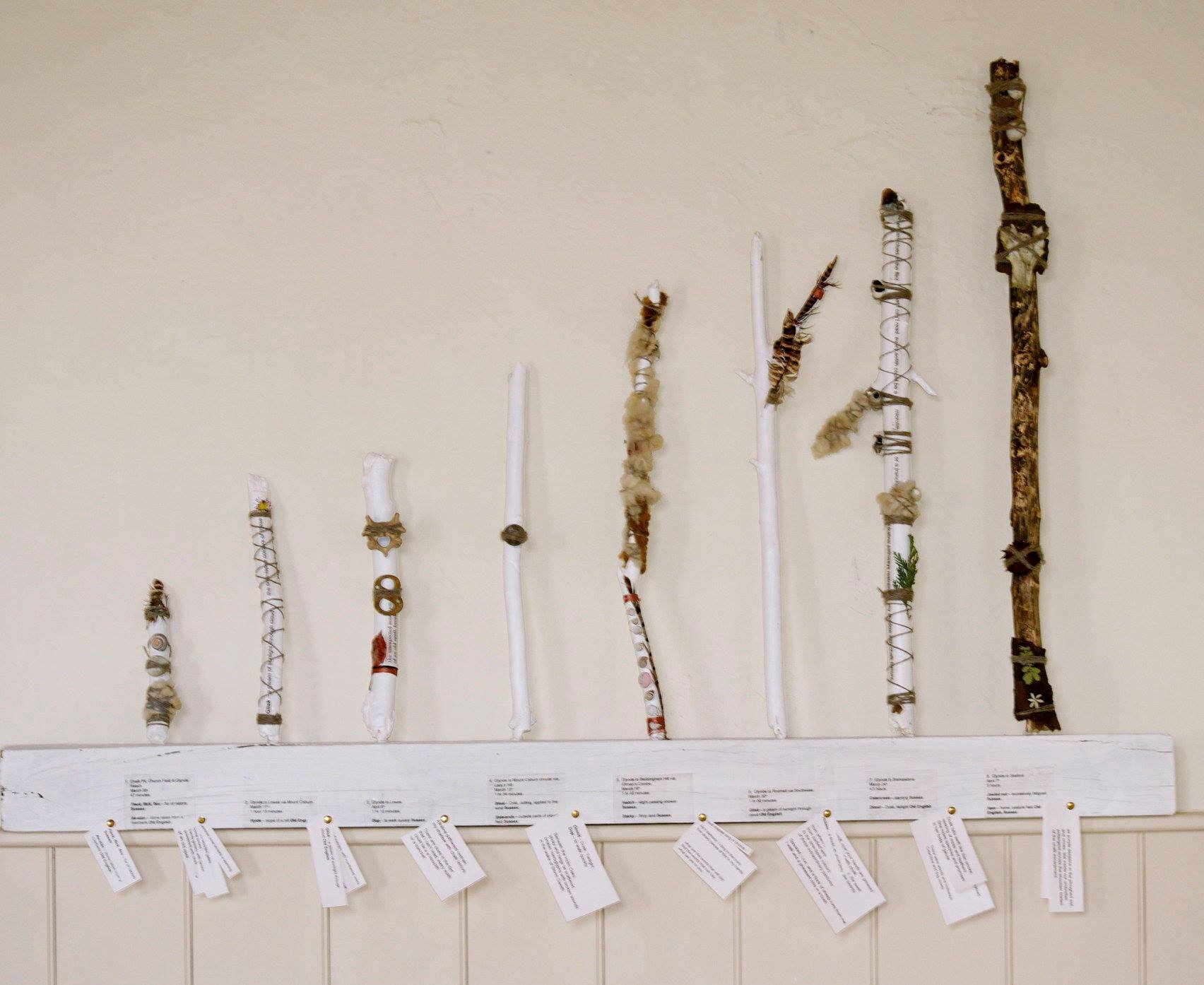
Securing a long-term tenancy in Glynde offered me a stable home for the first time in years, after a long period of housing insecurity. The journey sticks represent eight walks made from Glynde, the process of making them is a way of binding self to place. Tracing the landscape on foot reinforces a sense of belonging. Found objects and lost words are like collected charms, they capture the forces of nature, weave narratives and hold a certain timeless, magical quality characterised by the local terrain.
Wooden sticks feature in ancient cultures as emblems of power and imagination, they have been used as tools for mapping landscapes and storytelling.
Cyanotype prints (see image below) with their spectral representations of scenes and objects,brought to life by sunlight, suggest stories of place, moments in time, change and loss. I’m interested in the rituals of capturing, collecting and archiving, which offer feelings of comfort and impose a sense of order over nature and events that are often out of our control.
Book onto a Journey Sticks mini retreat in my Workshops page



cyanotype prints on an old door from a local cottage tell a story of home and belonging
Poems and words from walks in Sussex and Devon as part of 8 Journey’s Home:
Sharpham House. Dart Estuary
South Devon
Along west bank of the
River Dart via Ham Reach
& Woodland Glade
July 16th
4 hours
Dranget – a crowd of folks Devon
Oodwail – Green Woodpecker Devon
South West Devon Coast Path,
Berry Head Nature Reserve via
Scabbacombe Sands
July 17th
4.5 hours
Gakeing – daydreaming Devon
Palsh – walking slowly Devon
Dartmoor. Buckfastleigh circular via
Haytor, Hound Tor, Great Tor,
Cairn Circle, old quarry, wooded valley,
over the clapper bridge at Beck a Brook.
July 18th
7 hours
Overclap – clouds over-closing Devon
Twire – movement of shallow water Devon
Gallitrop – fairy ring Devon
Lyme Regis circular via Spittles Wood
and River Lym to the Cobb,
Lyme Regis seafront
July 20th
4 hours
Cockle – ripple on the water caused
by wind West Country
Bit an’ drop – snack, bit of food Dorset
Jurassic Coastal Path Lyme Regis,
dinosaur trail to Charmouth,
back via headland
July 21st
6 hours
Scraunching – withering with heat Devon, Dorset
Dimpsey – getting dark, twilight Dorset, Somerset
Twanketen – melancholy Dorset
Swallows
Swallows at Glynde Pool
Sleep that night was rocky, as if my blood were granular. Details of my circumstances, the ones I do not like pushed through, like old slogans under a peeling billboard. Perhaps it was the surreal disaster movie news before bed. The grief of wasted moments and gifts.
And you, who are far too young to have to question the certainty of anything beyond that distant vanishing point.
Bovine gloomy, we walked to the pool. Help yourself to anything, the morning chimed. Its kindness shamed me.
You hurried ahead of me.
Hedges, trees, fields, clouds.
There were endings everywhere.
The swimming pool was civic blue, deserted and serene. An odd opulence, having it to ourselves, amid this backdrop of cushioned Downs rising. A breeze swept fragrance across the scarp. Earth, beasts, grasses.
The peel of time and echoes, hand painted, long ago, summoned youth and lost voices.
Inch by inch we descended, watching the patina like a line of mercury trembling up our flesh. How the breath quickened in that menthol corset!
At chest depth we felt it, like pressure, like a shift in the barometer, and pausing, waited, letting our breath be our only movement.
Slick as a blink they came, first
a flash of cobalt oxide, then, an invasion
seven sharp boomerangs
Morning suited crimson throated
cleaving space. Elastic
catapulting
for a sip on the wing.
a sip of water’s skin.
Puffs of air fanned our cheekbones and we could trace the silver beads, slipping like oil from wing feathers.
So close -
for a moment the skin fell away and we were carried up and out. Then endings and time and vanishing points were just stories, limited perspectives.

Why Meditate?
Regular meditation can change your mind, your body and enhance your quality of life.
The Scientific Evidence Supporting the Benefits of a Daily Meditation Practise
The 1970s marked the beginning of the presence of mindfulness and meditation in Western culture and the amount of scientific research exploring the benefits of meditation on the mind and the body has increased, and more recently, dramatically accelerated as interest has snowballed.
In The Science of Meditation, Daniel Goleman and Richard David describe the leap from the small smattering of scientific articles on the subject in the 1970s to some 6,838 articles at the most recent count. Some of the most prominent scientific research has attempted to measure the affects of meditation on the brain.
The brain could be described as the engine room of the body as it plays a vital role in every one of the body’s systems. It stands to reason that any changes that occur in the brain will have consequential impacts on our entire physiology.
The effects of meditation on brain activity have been studied using neuroimaging technology such as MRI (Magnetic Resonance Imaging) and EEG (Electroencephalograph), which capture and monitor changes in the brain. An fMRI test is like a 3-D video of brain activity while an EEG uses electrodes attached to the scalp to track the brain’s electrical activity. Used together one compliments the other. The EEG is more accurate at tracking the timing of changes over seconds, while the fMRI maps the regions where brain activity occurs.
A 2008 study published in the Neuroimage Journal found that, after only 8 weeks of meditation, the left and right "hippocampi" of participants had grown in neural thickness, size and density. Given that studies have shown that the brain shrinks in people who experience long-term depression – findings concluded that meditation will counter act and/or reduce depression.
Other studies have looked at how brain waves change during meditation. There are five different types of brains waves, Beta, Alpha, Theta, Delta and Gamma. When our brainwaves are out of balance, there will be corresponding problems in our emotional or neuro-physical health. While Theta and Delta most commonly occur during sleep, Theta can also happen during deep meditative states and links to memory, and intuition. Beta is a common waking state brain wave, found during arousal and concentration but if this is dominant it can lead to a fight or flight response and increased cortisol. Alpha is the resting state of the brain and happens when we are relaxed and at ease. It helps with mental coordination, calmness, alertness, mind/body integration and learning. Gamma waves are the subtlest of the brain oscillations and the mind has to be very quiet to access them. Gamma occurs when different brain regions fire in harmony, such as in moments of insight. Researchers have found it is most active when in states of compassion, universal love and the ‘higher virtues’. A greater presence of Gamma relates to expanded consciousness and spiritual emergence.
A study published in the neuroscience journal Brain Research Bulletin, revealed that the brains of people who meditate regularly had elevated Alpha rhythms – the healthy brain waves that induce calm, and the ‘Relaxation Response’. A number of key studies have found that Alpha brain waves are likely to occur even in the brains of beginner meditators during meditation. A study at the Norwegian University of Science and Technology discovered both Theta and Alpha brainwaves in participants while they practised a nondirective meditation. In these tests Neuro-imaging showed that Alpha brainwaves were more active in the posterior part of the brain during the meditation sessions while Theta waves occurred in the frontal and middles parts of the brain.
In an experiment at the University of Wisconsin –Madison, Tibetan Buddhist master Mingyur Rinpoche and 21 Buddhist monks allowed lead researcher Richard Davidson to conduct a series of tests on their brain activity during meditation. What Davidson found was that during meditation Rinpoche and the monks were able to generate constant Gamma brainwaves and even had increased Gamma oscillations after the meditation during everyday neural activity. Gamma waves are the most elusive and normally only occur for brief periods in most people’s brains. What the above studies show is that meditation has positive and long-term benefits for the brain even for beginner meditators, but that these benefits and changes to the brain become more dramatic in very experienced and regular practitioners.
Chronic stress will cause an imbalance in brain activity, and vice versa and threatens both mental and physical health. Inflammation has been linked to chronic stress and is a major cause of illness including heart disease, diabetes, stroke, arthritis, depression and a range of autoimmune disorders, (it has also recently been linked to gut health).
A recent study carried out by Dr. David Creswell, a professor of psychology
At the Carnegie Mellon University found that inflammation was reduced in participants after a course of mindfulness and meditation. Brain scans showed increased functional connectivity between two brain areas that normally work in opposition. Blood samples showed that participants who underwent the mindfulness training had lower levels of Interleukin-6, a biomarker of inflammation, than those who did relaxation alone.
To conclude, meditation has the power to dramatically impact neural activity and improve brain health, which in turn can help to improve emotional and mental wellbeing and reduce the stress hormones that lead to chronic disease.
These benefits have been recorded in both beginner and experienced meditators but long term and regular practise pays the highest dividends.
Sources and further reading
· Data relating to number of scientific articles on mediation: The Science of Meditation. Daniel Goleman & Richard J. Davidson. Penguin
· EEG and fMRI explanations: The Science of Meditation. Daniel Goleman & Richard J. Davidson. Penguin
· Brain Waves research: https://brainworksneurotherapy.com/what-are-brainwaves
· Effect of meditation on hippocampi: https://www.ncbi.nlm.nih.gov/pmc/articles/PMC3004979/
· Meditation increases Alpha brain waves: https://www.technologyreview.com/s/425109/your-brain-on-meditation/
https://www.sciencedaily.com/releases/2010/03/100319210631.htm
· Gamma brain waves during meditation in brains of Buddhist monks:
and https://www.scientificamerican.com/article/zen-gamma/
· Effects of meditation and mindfulness on brain and inflammation: huffintonpost.co.uk/entry/meditation-brain-changes-study-us/
Inflammation is a killer - but meditation can help fight it
Prolonged stress and high cortisol levels, diet and other lifestyle and environmental imbalances can mean the inflammation response is constantly triggered, leading to chronic inflammation….and disease. Meditation can help reduce the inflammatory response.
Inflammation is the body’s way of defending against things that might harm it, such as infections, injuries and toxins. When something damages your cells, your body releases chemicals that trigger a response from your immune system. Messengers called inflammatory mediators tell blood vessels and cells to promote an inflammatory response. Inflammatory mediators include prostaglandins, and inflammatory cytokines.
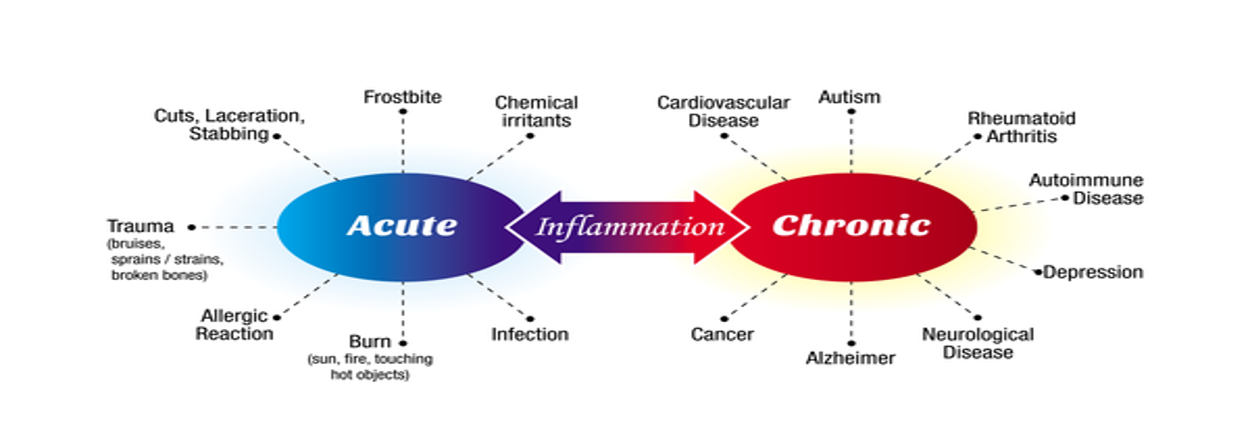
Prolonged stress and high cortisol levels, diet and other lifestyle and environmental imbalances can mean the inflammation response is constantly triggered, leading to chronic inflammation….and disease.
Chronic inflammatory diseases are the most significant cause of death in the world:
•Autoimmune diseases like rheumatoid arthritis.
•Cancer, heart disease, arthritis, type 2 diabetes, obesity, asthma
•Depression, anxiety and other mental health issues
•Neurodegenerative diseases such as Alzheimer’s disease.
Inflammation on your mental health:
•Psychological stress can activate inflammation
•Inflammation does not necessarily cause mental illness but in scientific studies, inflammation was present in a wide range of disorders. Studies found increased concentrations of a variety of inflammatory markers in depressed patients —one such biomarker of inflammation is interleukin – 6 (a pro inflammatory cytokine).
The gut brain connection
In his book, The Mind Gut Connection – Emeran Mayer explores the close connections our gut has with our moods and even our cognitive processing. Mayer provides plenty of surprising facts, such as that 95% of the body's serotonin is stored in the gut. The gut and the brain are constantly signalling to each other.
Studies have investigated mechanisms related to brain inflammation, microbiomes and stress, which all influence one another:
•Scientists transplanted gut bacteria from stressed rats into rats who were not stressed, test showed that anxiety and depression increased in the previously non-stressed rats
•Scientists also noticed that stress increased inflammation in the brains of vulnerable rats, and that this inflammation appeared in unstressed rats after they received transplants from vulnerable animals.
Mindfulness Meditation and its impact on Inflammation
Dr. David Creswell, a professor of psychology at the Carnegie Mellon University carried out a study and found that inflammation was reduced in participants after a course of mindfulness meditation.
•Researchers recruited 35 stressed-out adult job-seekers
•Half completed an intensive three-day mindfulness meditation retreat program
•Half completed a three-day relaxation retreat program that did not have a mindfulness component.
•Brain scans and blood tests were taken before and after the study
•Blood samples showed that participants who underwent the mindfulness training had lower levels of Interleukin-6, a biomarker of inflammation, than those who did relaxation alone.
•Brain scans revealed that meditation increased functional connectivity between two brain areas that typically work in opposition: the default mode network (which is involved in mind-wandering and internal reflection) and the executive attention network (key to attention, planning and decision-making). Relaxation training did not have this effect.
"Mindfulness meditation teaches participants how to be more open and attentive to their experiences, even difficult ones," Creswell said. "By contrast, relaxation approaches are good in the moment for making the body feel relaxed, but ... [they're] harder to translate when you are dealing with difficult stressors in your daily life."
Creswell and his colleagues found that the daily practice of mindfulness meditation lowers inflammatory molecules by about 15% and was much more effective than a counseling based approach.
Short and long term practise
Similar studies have shown even 3 days of mindfulness training produces a short term decrease in pro-inflammatory cytokines. But long term practice has wider benefits: neuroimaging studies have shown that even at rest regular meditators have lower levels of pro-inflammatory cytokines.
After just one day of meditating a group of experienced Vipassana practitioners showed a marked ‘down-regulation’ of inflammatory genes, suggesting that beginner meditators will benefit from the kind of anti-inflammatory stress reduction that mindfulness offers. And if sustained over a lifetime, meditation might help fight or even prevent diseases linked to inflammation which include many of the world’s major physical and mental health problems.